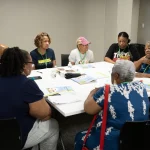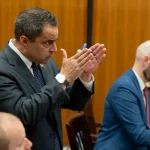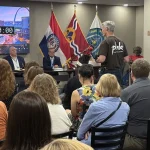

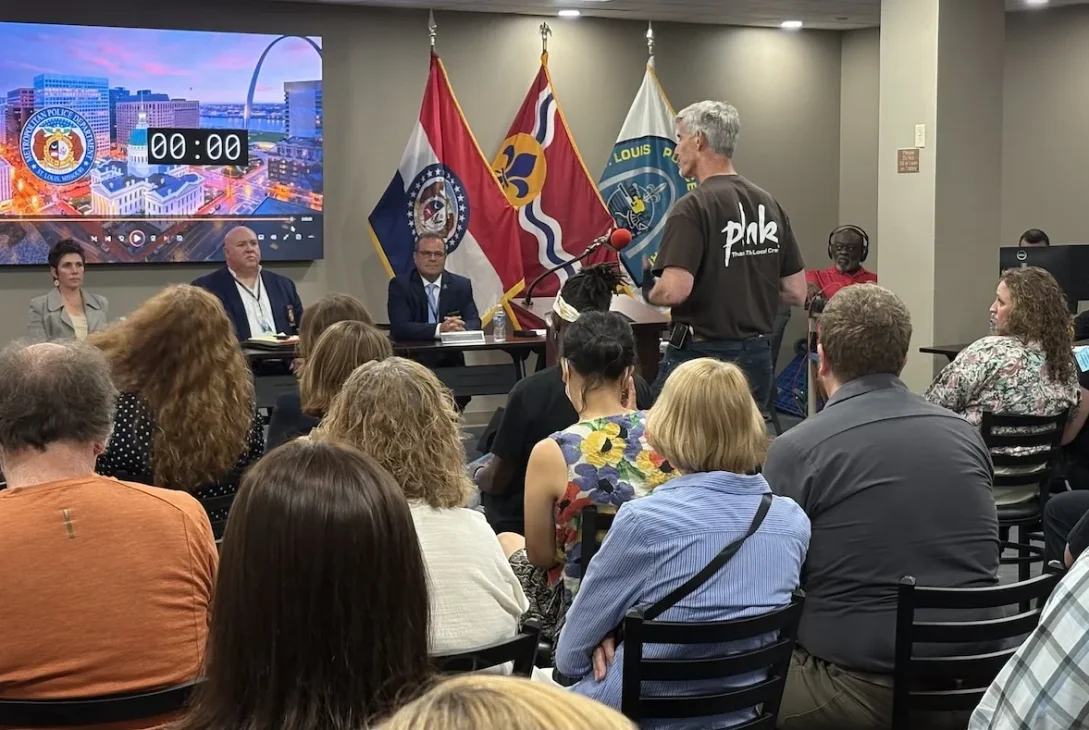
During a Wednesday meeting, the state-appointed Board of Police Commissioners opened its doors to public feedback. The attendees expressed a clear consensus: they were dissatisfied with the board’s direction and approach.
John Parker, proprietor of O’Connell’s Pub in South City, was among the first to address the board. While he has long championed higher police salaries, he questioned the board’s methodology. “What’s not logical is how this is happening,” he stated, comparing the board’s actions to a child eager to open Christmas gifts on December 20. “It’s not that you’re wrong—it’s how you’re doing it.”
Get a fresh take on the day’s top news
We will never send spam or annoying emails. Unsubscribe anytime.
Multiple speakers highlighted that Mayor Cara Spencer is the board’s sole elected member, yet she has faced unwarranted criticism from other board members.
Central West End resident James Dwyer observed: “From this outsiders’ perspective, the optics are not good.”
Board President Chris Saracino maintained order by implementing a digital timer that counted down from two minutes for each speaker. While some initially questioned this approach, it proved effective in keeping discussions on track. Speakers who exceeded their time limit were permitted to continue.
David Stokes, representing the libertarian Show-Me Institute, criticized the board’s proposal to claim a portion of the Rams settlement funds as misguided. (Stokes, a frequent public meeting participant, complimented the timer’s modern design.)
Public complaints extended beyond concerns about the mayor’s marginalization. Residents also worried that increased police funding would diminish other city services, questioned the lack of drug testing for officers involved in vehicle accidents, and alleged that commissioner Don Brown faces a conflict of interest by serving on the board while his auto dealerships conduct business with the police department.
Alderwomen Alisha Sonnier and Daniela Velazquez also testified, expressing criticism of the board and its first year of operation. Sonnier reiterated her support for police departments operating under local control.
“I don’t understand how going to battle with the city at every turn is improving the perception of the city, making our city safer,” Velazquez remarked. Following the meeting, she warned that the board might secure a pyrrhic victory—a larger budget achieved at the cost of public confidence.
Beyond prominent community figures like Stokes, Parker, Dwyer, and the alderwomen, several locally recognized individuals offered their perspectives.
Reverend Neal M. Thompson, whose business card identifies him as a spiritual advisor and the “Jesus guy,” stated, “If we didn’t have this war machine going on, we could all have free food, free housing, free medical.” (His comments’ relevance to the police board remained unclear.)
Jazzmine Nolan-Echols, who has had her own notable experiences with city boards, questioned why the mayor’s salary wasn’t subject to the same scrutiny as police officers’ compensation. She may have been the sole speaker who didn’t criticize the police board, though this remained ambiguous.
The Police Board anticipated some level of criticism during Wednesday’s meeting, though the extent and nature remained uncertain. While speakers uniformly opposed the board, some comments were easily dismissible. One speaker made vague references to hidden financial influences, while another broadly criticized police as “racist, transphobic, and work with ICE.”
Conversely, several speakers acknowledged they hadn’t voted for Spencer—one labeled her “data center Spencer”—yet supported her position in this particular matter. Overall, attendees demonstrated more decorum than those present at recent aldermanic hearings on Rams settlement spending, despite overlapping attendees. (The crowd expressed agreement through finger-snapping rather than vocal affirmations, unlike at the previous Board of Aldermen session.)
Following public comment, commissioners offered brief remarks.
Don Brown noted his dealership has supplied vehicles to the police department since 1985, consistently winning contracts through competitive bidding processes.
Saracino stated, “Public input is important to our work. All comments made today will be considered where appropriate.”
The meeting also addressed proposed salary increases for police command staff, which Mayor Spencer had previously opposed. She succeeded in postponing the vote from two weeks prior to Wednesday’s meeting. Spencer reiterated her concerns about the timing, particularly since police command raises would necessitate corresponding firefighter increases. “We have scrambled in the eleventh-point-nine hour,” she remarked.
The raises were approved by a vote of 4-1.
Following the meeting, SLM asked Sonnier whether she was surprised by the unanimous opposition to the board. She was not.
“This is the least popular thing in St. Louis right now,” she said. “I think this and that sinkhole are going neck and neck.”
Editor’s note: A previous version of this story misstated Neal Thompson’s moniker.